| Model |
CW9178I |
| Software |
● Cisco IOS® XE Software Release 17.15.2 or later |
| Supported wireless LAN controllers |
● Catalyst 9800 Series Wireless Controllers (physical or virtual) |
| ● Cisco Catalyst 9000 switches with Embedded Wireless Controller in SDA mode |
| 802.11be |
● 4x4 + 4x4 uplink/downlink MU-MIMO with 4 spatial streams each (5 GHz) |
| ● 4x4 uplink/downlink MU-MIMO with four spatial streams (2.4 and 6 GHz) |
| ● 4096 QAM |
| ● Multilink operation |
| ● Preamble puncturing |
| ● Uplink/downlink OFDMA |
| ● TWT |
| ● BSS coloring |
| ● Maximal Ratio Combining (MRC) |
| ● 20-, 40-, 80-, 160- and 320-MHz channels (6 GHz) |
| ● 20-, 40-, 80-, and 160-MHz channels (5 GHz) |
| ● 20-MHz channels (2.4 GHz) |
| ● PHY data rates: in Quad radio mode, up to 24 Gbps (4x4 320 MHz on 6 GHz, 4x4 + 4x4 160 MHz on 5 GHz, and 4x4 20 MHz on 2.4 GHz); in Tri radio mode, up to 18 Gbps (4x4 320 MHz on 6 GHz, 4x4 160 MHz on 5 GHz, and 4x4 20 MHz on 2.4 GHz) or PHY data rates up to 23 Gbps (4x4 320 MHz on 6 GHz, 4x4 160 MHz on 5 GHz and 4x4 160 MHz on 5 GHz) |
| ● Packet aggregation: Aggregate MAC Protocol Data Unit (A-MPDU) (transmit and receive), Aggregate MAC Service Data Unit (A-MSDU) (transmit and receive) |
| ● 802.11 Dynamic Frequency Selection (DFS) |
| ● Cyclic Shift Diversity (CSD) support |
| ● Wi-Fi Protected Access 3 (WPA3) support |
| 802.11ax |
● 4x4 + 4x4 uplink/downlink MU-MIMO with four spatial streams each (5 GHz) |
| ● 4x4 uplink/downlink MU-MIMO with four spatial streams (2.4 and 6 GHz) |
| ● Uplink/downlink OFDMA |
| ● 1024 QAM |
| ● TWT |
| ● BSS coloring |
| ● MRC |
| ● 802.11ax beamforming |
| ● 20-, 40-, 80-, and 160-MHz channels (5 and 6 GHz) |
| ● 20-MHz channels (2.4 GHz) |
| ● PHY data rates up to 10.2 Gbps (4x4 160 MHz on 6 GHz, 4x4 + 4x4 80 MHz on 5 GHz, and 4x4 20 MHz on 2.4 GHz) |
| ● Packet aggregation: A-MPDU (transmit and receive), A-MSDU (transmit and receive) |
| ● 802.11 DFS |
| ● CSD support |
| ● WPA2/WPA3 support |
| 802.11ac |
● 4x4 + 4x4 downlink MU-MIMO with 4x4 spatial streams |
| ● MRC |
| ● 802.11ac beamforming |
| ● 20-, 40-, 80-, and 160-MHz channels |
| ● PHY data rates up to 3.4 Gbps (dual 4x4 160 MHz on 5 GHz) |
| ● Packet aggregation: A-MPDU (transmit and receive), A-MSDU (transmit and receive) |
| ● 802.11 DFS |
| ● CSD support |
| ● WPA2/WPA3 support |
| Integrated antenna |
● 2.4 GHz: Peak gain 4 dBi, internal antenna, omnidirectional in azimuth |
| ● 5 GHz: Peak gain 5 dBi, internal antenna, omnidirectional in azimuth |
| ● 6 GHz: Peak gain 6 dBi, internal antenna, omnidirectional in azimuth |
| ● IoT: Peak gain 3 dBi, internal antenna, omnidirectional in azimuth |
| ● UWB: Peak gain 7 dBi, internal antenna, omnidirectional in azimuth |
| ● GNSS: (L1) Peak gain 5 dBi, (L5) Peak gain 2 dBi, internal antenna, omnidirectional in azimuth |
| Interfaces |
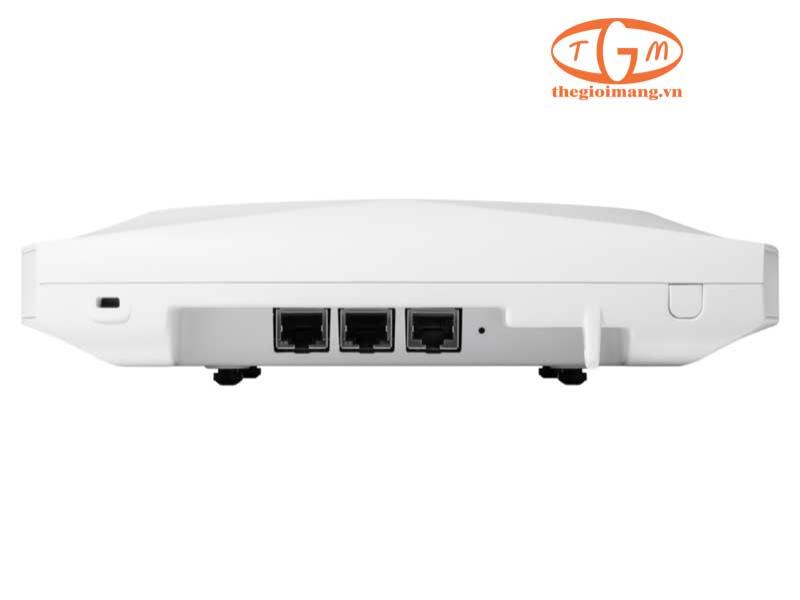
● 2x 100M/1000M/2.5G/5G/10G Multigigabit Ethernet (RJ-45) |
| ● Management console port (RJ-45) with default speed of 115200 bps |
| ● USB 2.0 at 9W |
| Indicators |
● Status LED indicates boot loader status, association status, operating status, boot loader warnings, and boot loader errors |
| Dimensions (W x L x H) |
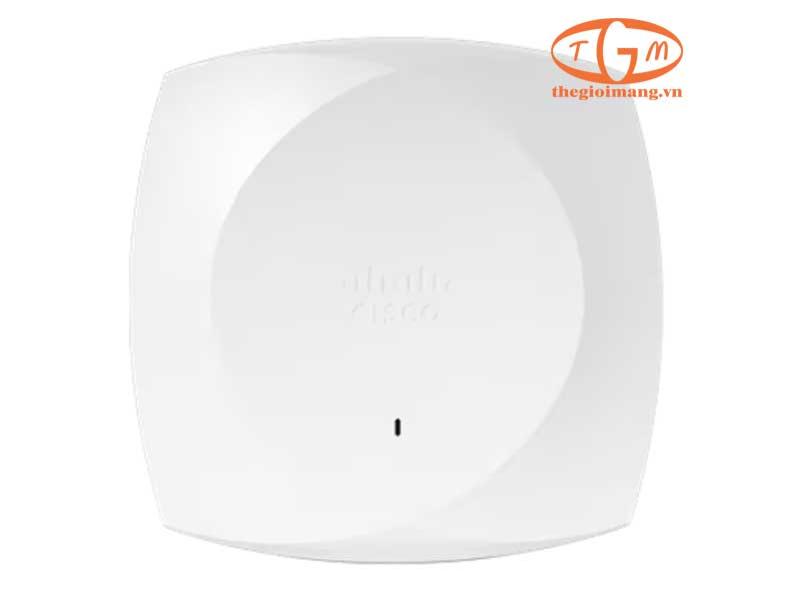
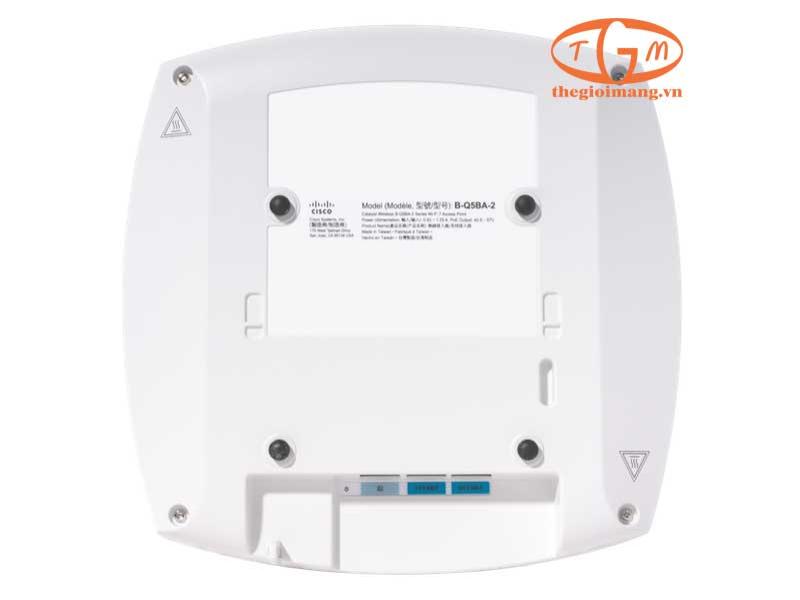
● Access point (without mounting brackets): 9.9 x 9.9 x 2.0 in. (25.1 x 25.1 x 5.1 cm) |
| Weight |
● 4.1 lb. (1.87 kg) |
| Input power requirements |
● 802.3bt Cisco Universal PoE (Cisco UPOE®), 802.3at Power over Ethernet Plus (PoE+), 802.3af
PoE (only for configuring staging, all radios off) |
| ● (Or) Cisco Power Injector – CW-INJ-8 |
| Environmental |
● Nonoperating (storage) temperature: -22° to 158°F (-30° to 70°C) |
| ● Nonoperating (storage) altitude test: 25˚C (77°F) at 15,000 ft (4570 m) |
| ● Operating temperature: 32° to 122°F (0° to 50°C) |
| ● Operating humidity: 10% to 90% (noncondensing) |
| ● Operating altitude test: 40˚C (104°F) at 9843 ft (3000 m) |
| Note: When the ambient operating temperature exceeds 40˚C (104˚F), the access point will shift from 4x4 to 2x2 on the 2.4-GHz, 5-GHz and 6-GHz radio(s); however, the USB interface will remain enabled. |
| System memory |
● 4096 MB DRAM |
| ● 16 GB storage flash |
| Available transmit power settings |
2.4 GHz |
5 GHz |
6 GHz |
| ● 23 dBm (200 mW) |
● 23 dBm (200 mW) |
● 23 dBm (200 mW) |
| ● -4 dBm (0.39 mW) |
● -4 dBm (0.39 mW) |
● -4 dBm (0.39 mW) |
| Certifications |
● Wi-Fi Alliance: Wi-Fi 7 (R1), Wi-Fi 6 (R2), Wi-Fi 6E, WPA3-R3, WPA3-Suite B, Enhanced Open Security |
| ● Bluetooth SIG: Bluetooth Low Energy |



 Switch Cisco
 Switch Meraki
 Switch HPE Aruba
 Switch Huawei
 Switch Alcatel
 Switch Extreme
 Switch Juniper
 Switch Fortinet
 Switch Allied Telesis
 Switch Unifi
 Firewall FortiNet
 Firewall Cisco
 Firewall SonicWall
 Firewall CheckPoint
 Firewall Sophos
 Firewall WatchGuard
 Firewall Meraki
 Firewall PaloAlto
 Firewall Huawei
 Router Cisco
 Router Huawei
 Router Juniper
 Router HPE
 Router Mikrotik
 Wifi Cisco
 Wifi Extreme
 Wifi Meraki
 Wifi Huawei
 Wifi Alcatel
 Wifi Fortinet
 Wifi Aruba
 Wifi Unifi
 Module Cisco
 Module Fortinet
 Module Mikrotik
 Server Dell
 Server HPE
 Server Cisco
 NAS Synology
 NAS Qnap
 Microsoft Software
 Kaspersky License
 Zoom License
 Video Conference
 Điện thoại IP
 Bộ lưu điện UPS
 Tủ Rack
 Cáp quang
 Cáp mạng
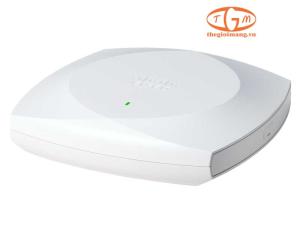
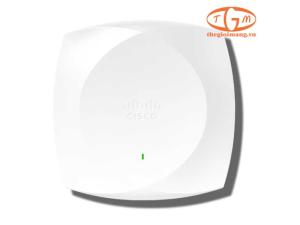

Cisco CW9178I có những yêu cầu gì về nguồn cấp và phần cứng để đạt hiệu năng tối đa?
Cisco CW9178I được trang bị 2 cổng Multigigabit Ethernet hỗ trợ tốc độ từ 100 Mbps đến 10 Gbps, 4 GB DRAM, 16 GB Flash, 1 cổng USB 2.0 (9W) và 1 cổng console RJ-45. Để khai thác đầy đủ hiệu năng của Wi-Fi 7 và các radio tích hợp, thiết bị khuyến nghị sử dụng nguồn 802.3bt Cisco UPOE hoặc 802.3at PoE+; nếu chỉ cấp nguồn bằng 802.3af PoE, Access Point chỉ hỗ trợ configuration staging và toàn bộ các radio sẽ bị tắt. Điều này giúp đảm bảo thiết bị luôn hoạt động với hiệu suất tối đa trong môi trường doanh nghiệp hiện đại.
Cisco CW9178I hỗ trợ những tính năng nào phục vụ hệ sinh thái IoT và định vị?
Ngoài chức năng cung cấp kết nối Wi-Fi, Cisco CW9178I còn tích hợp Bluetooth Low Energy (BLE), Ultra-Wideband (UWB) và GNSS (L1/L5) với các ăng-ten chuyên dụng. Nhờ đó, thiết bị có thể hỗ trợ các ứng dụng định vị trong nhà (indoor positioning), theo dõi tài sản (asset tracking), dẫn đường, quản lý thiết bị IoT và các giải pháp tự động hóa trong doanh nghiệp, bệnh viện, nhà máy hoặc trung tâm logistics mà không cần triển khai thêm phần cứng chuyên biệt.
Những công nghệ nào giúp Cisco CW9178I nổi bật so với các Access Point Wi-Fi 6/6E?
Cisco CW9178I là Access Point Wi-Fi 7 (IEEE 802.11be), tích hợp nhiều công nghệ mới như 4096-QAM, Multi-Link Operation (MLO), Preamble Puncturing và hỗ trợ kênh truyền 320 MHz trên băng tần 6 GHz. Thiết bị còn hỗ trợ 4x4 + 4x4 MU-MIMO trên băng tần 5 GHz, 4x4 MU-MIMO trên 2.4 GHz và 6 GHz, giúp đạt tốc độ PHY tối đa 24 Gbps ở chế độ Quad Radio. Những công nghệ này mang lại thông lượng cao hơn, giảm độ trễ và tăng hiệu quả sử dụng phổ tần so với các Access Point Wi-Fi 6/6E.